What Ostrog is
Ostrog Monastery clings to the face of a near-vertical cliff in the Ostroška Greda massif, whitewashed against grey limestone at an altitude of around 900 metres. It's the most-visited Orthodox site in Montenegro, credited with drawing over 100,000 pilgrims and tourists a year, and the resting place of its founder, Saint Basil of Ostrog.
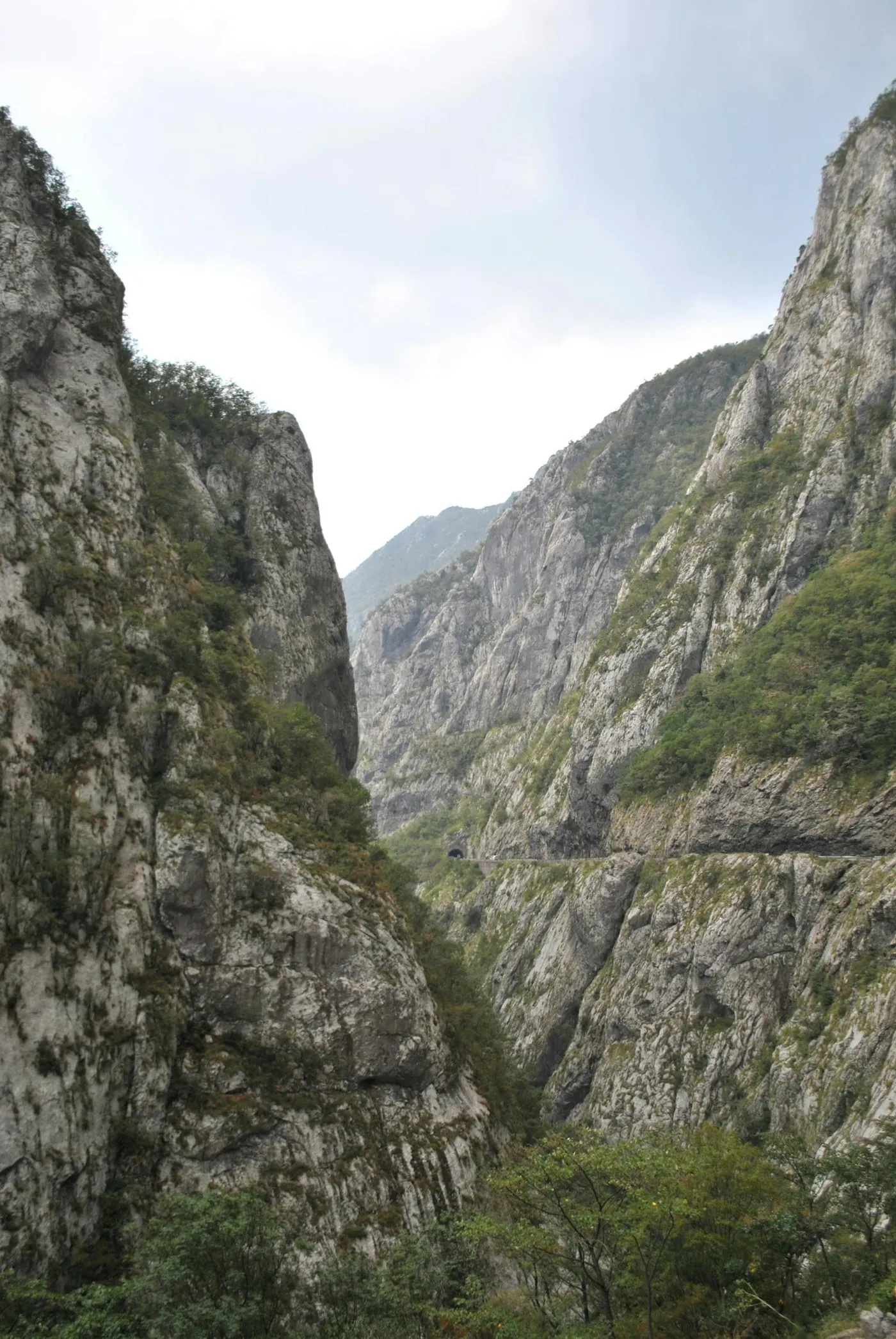
Saint Basil, born Stojan Jovanović in 1610 in the Herzegovinian village of Mrkonjić, became Bishop of Ostrog in 1651 and died at the monastery in 1671. The monastery's modern form dates to a 1923-1926 rebuild after fire destroyed most of the complex, only the two cave churches were spared, which is why they remain the heart of any visit today. Ostrog pairs naturally with the Morača Canyon drive for a full day of holy sites and gorge roads.
The final section above the lower monastery is single-track in places with drops on the outside edge, so a small hatchback from the compact end of the Podgorica rental fleetis far less stressful to reverse into a passing bay than a wide estate.
The route from Podgorica
The drive is roughly 32 km and takes under an hour in light traffic, though plan closer to 90 minutes if you're heading up in summer. Head north on the M-2 highway toward Nikšić. You'll pass through the Bjelopavlići plain, and the Ostroška Greda cliff becomes visible on your right before you reach the village of Bogetići.
From Bogetići, follow signs for Donji Ostrog (Lower Monastery) or Gornji Ostrog (Upper Monastery). An alternative is to turn off earlier at Danilovgrad and take the secondary highway.
The hairpin road up
From the Lower to the Upper Monastery, a narrow single-track road climbs around 500 metres through a series of tight hairpins and blind corners. It is considered too narrow for full-sized coach buses, so pilgrim groups park at the Lower Monastery and take smaller shuttles or walk up.
Most sections allow two cars to pass with care, but at blind corners slow to a crawl. There are several viewpoint pull-offs on the way up, pull all the way over before stopping. Coming back down, use engine braking rather than riding the pedal, or you'll cook the brakes.
Most people make Ostrog a half-day run and are back in the capital by mid-afternoon, which is why picking the car up at one of the collection points around Podgoricaworks better than starting from the coast.
Parking options
There are three main car parks. The first is at the Lower Monastery (Donji Ostrog), on the valley floor. A second small lot is a few hairpins up. A larger car park sits near the Upper Monastery, though it fills quickly in peak season. If it's full, you'll be turned back to the Lower Monastery and can walk up via pilgrim paths, roughly 45 minutes to an hour.
Many visitors deliberately park low and walk anyway, for the pilgrimage experience.
Live rental prices for your exact dates.
Free cancellation available on many cars
Inside the Upper Monastery
The main chapel (the Church of the Presentation) is carved directly into the rock. Its frescoes date to the late 17th century. A second smaller chapel, the Church of the Holy Cross, sits above it on the upper level, painted by the master Radul. Inside, space is tight, and there's often a quiet queue to approach Saint Basil's relics.
Dress modestly: covered shoulders, knees covered. Scarves and wraps are usually available at the entrance. Photography is permitted on the terraces but discouraged inside the chapels.
Where to eat on the way down
The valley floor around Bogetići and Danilovgrad has several traditional restaurants serving lamb and veal cooked under a metal bell (sač). Ask at the Lower Monastery shop for the nearest recommendation, the monks know the area. Back in town, our Podgorica food guide covers the city's best dinner options.
Practical tips
- Start early: Aim to leave Podgorica by 08:00 in summer. The Upper Monastery car park fills by mid-morning.
- Vehicle: Any standard car is fine, no 4x4 needed. Low-slung sports cars handle it too, just slowly.
- Fuel: Fill up in Podgorica. The last reliable stations are around Danilovgrad and Bogetići.
- Dress: Shoulders and knees covered. Carry a light layer, the chapel interior is cool year-round.
- Traditional barefoot walk: Devout pilgrims walk the 3 km from Lower to Upper Monastery barefoot, especially in summer. You'll see small groups on the pilgrim path.
- Combine with: Morača Monastery further north, or return via the Zeta Valley.
Driving this route yourself
The Podgorica to Niksic road is dual carriageway for the first stretch and easy going, with fuel at Danilovgrad and Bogetici before you turn off. The climb is where it changes. Tarmac is sound but narrow, the gradient is sustained, and second gear does most of the work on the hairpins. Come down in low gear rather than riding the brakes, which fade on that descent. Coaches use the same road, so expect to reverse to a wider point occasionally. Aim for early morning on a saint's day or through August, when the upper car park fills and cars end up strung along the verge below. Winter brings ice and fog above 800 metres, and the road may close briefly after snow. A short car with good visibility beats power here.
Next up
Ostrog pairs well with our Morača Canyon drive if you have a full day and want to continue north toward Kolašin.
At a glance
Live rental prices for your exact dates.
Free cancellation available on many cars